
SAFEFLOW
What is a permit to work system?
Published

General information, not legal advice. Check the full official text of each Thai regulation and consult your own legal or safety advisor before applying anything here to your site.
Many serious incidents in process industries happen not during normal production but during maintenance, cleaning, modification and shutdown work, when people open equipment that normally stays closed, bring ignition sources into areas that normally have none, and work alongside contractors who do not know the site. A permit to work system is the formal way a site decides who may do that kind of non-routine work, where, when, and under which precautions.
This article explains what a permit to work system is, how it is organised, and what organisations in Thailand should pay attention to, from safety officers (jor-por) and maintenance planners to production supervisors.
What a permit to work system is for
A permit to work is a written document that authorises specific people to carry out specific work at a specific place and time, and that lists the hazards and the precautions required before and during the job. The UK Health and Safety Executive guidance HSG250 describes it as part of a wider safe system of work, not as a form to be filled in for its own sake.
A good system does four things:
- Forces a hazard review before work starts. Someone who understands the site must look at the job and decide what could go wrong.
- Communicates precautions clearly. The people doing the job, the people in charge of the area and the people approving it all see the same conditions.
- Controls the interface between maintenance and operations. Production must know the equipment is being worked on, and maintenance must know the equipment has been made safe.
- Leaves a record. If something goes wrong, the organisation can see who approved what, and on what basis.
In Thailand, the Occupational Safety, Health and Environment Act B.E. 2554 is the parent law on workplace safety. Several Ministerial Regulations relate to specific controls, such as authorisation before confined space entry, and no single regulation is titled "permit to work". A permit system is a practical way for an organisation to apply such controls consistently, but check the official text of each regulation that applies to your site.
Common permit types
Organisations usually group high-risk work into permit types, each with its own checklist:
| Permit type | Typical hazards controlled |
|---|---|
| Hot work | Welding, cutting, grinding near flammable materials |
| Confined space entry | Oxygen deficiency, flammable or toxic gas, engulfment |
| Electrical work | Contact with live parts, unexpected re-energising |
| Line break / opening process equipment | Release of pressure, chemicals or steam |
| Work at height | Falls of people and dropped objects |
| Excavation | Collapse, buried services, vehicle traffic |
| Lifting | Crane lifts over people or live process equipment |
Some organisations use a general "cold work" permit for everything else that is non-routine. Many jobs need more than one permit, for example entering a vessel to weld inside it needs a confined space entry permit, a permit for the hot work, and isolation.
Who does what: the key roles
HSG250 stresses that roles must be clearly defined and that people must be trained and competent for the role they hold. Titles vary between organisations, but the functions are similar:
- Requester or performing authority: the supervisor of the team doing the work, often a contractor supervisor, who describes the job and accepts the permit conditions.
- Area authority: the person responsible for the area or unit, usually from production, who knows what is running, what is in the pipes and what other work is happening nearby.
- Issuing authority or approver: the person who checks that hazards are identified and precautions are adequate, then signs to issue the permit. Higher-risk work often needs several approval steps.
- Isolating authority: the person who carries out and verifies isolation of energy sources.
- Gas tester: a trained person who tests the atmosphere and records readings.
- Safety officer: reviews risk, audits permits in the field, and advises on precautions.
For confined space work, the Ministerial Regulation on confined spaces B.E. 2562 also relates to roles and specific training for the people involved. Role names and details should be checked in the full text.
The permit lifecycle
A permit is not a single signature. It moves through stages, and each stage has its own checks.
1. Planning and request
The requester describes the job, location, equipment, duration and the people involved. The task risk assessment or job safety analysis is attached.
2. Review and preparation
The area authority and approvers review hazards and decide precautions: isolation, draining and purging, gas testing, fire watch, barriers, PPE. Preparation work is then carried out and verified.
3. Issue and acceptance
The approver signs the permit. The performing authority reads the conditions, confirms the team understands them, and signs to accept. Only then can work start.
4. Work in progress and monitoring
The permit stays at the job site, visible. Conditions are checked during the work, for example by repeated gas tests. If conditions change, work must stop and the permit is suspended.
5. Handover between shifts
Long jobs cross shifts. Shift handover is a common weak point. The outgoing and incoming supervisors should walk through open permits, status of isolations and any changes, and sign the handover.
6. Close-out
When work is complete, the performing authority confirms the area is left safe, tools are removed and people are out. The area authority checks the site before isolations are removed and the equipment is returned to operations. The permit is then closed and filed.
Links to isolation, gas testing and SIMOPS
A permit is only as strong as the controls it references. Three links matter in particular.
Isolation and lockout/tagout (LOTO). Before work on equipment, energy sources must be isolated and locked. The Ministerial Regulation on electrical safety B.E. 2558 relates to safe work on electrical systems, including maintenance, so check its text for what applies to your isolation practice. HSE guidance HSG253 covers isolation of process equipment in detail. The permit should list every isolation point, and work should not start until each one is confirmed.
Gas testing. For confined spaces and hot work near flammables, the permit should record atmosphere test results. Commonly used reference values are oxygen between 19.5% and 23.5% by volume and flammable gas below 10% of the lower flammable limit (LFL, also called the lower explosive limit, LEL). These are commonly used values; check the definition of a hazardous atmosphere in the relevant regulation (see the sources below) and your organisation's own criteria. For toxic gases, use the criteria set by law and by your organisation. Test oxygen first, then flammables, then toxics, at top, middle and bottom, and re-test after breaks. Check the regulations and standards that apply, and follow your site limits where they are stricter.
Simultaneous operations (SIMOPS). Each permit may be safe on its own, yet two jobs in the same area can create a new hazard together, such as hot work next to a line break that may release flammable vapour. Teams control this with an interaction matrix that marks pairs of work as allowed, conditional or not allowed, and with a daily permit coordination meeting led by area authorities.
Paper versus electronic permit systems
Paper permits in carbon-copy books are still common. Paper is familiar and works in the field, but it has well-known weaknesses:
- Permits are scattered across offices and job sites, so nobody sees all open work in a zone at once.
- Clashes between jobs depend on the memory of whoever approves.
- Isolation status, gas readings and handovers are written by hand and are hard to verify later.
- Searching past permits for an incident investigation or audit takes days.
An electronic system keeps one source of truth for every permit, applies the same approval steps every time, and can check conditions such as isolation status or job clashes automatically. It does not replace field checks or competent people. A walk-down by the area authority is still essential. For the document side of a management system, see our article on document control for ISO 9001.
Running permits electronically with SAFEFLOW
Whichever system you choose, the principles from HSG250 stay the same: clear roles, proper hazard review, verified isolation, recorded gas tests, careful handover and a clean close-out. The question is how reliably those steps happen on a busy day.
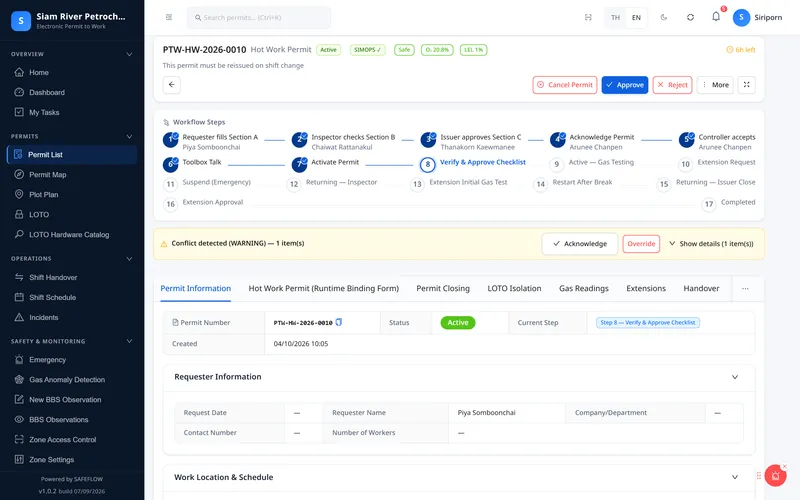
SAFEFLOW is a permit to work system in Thai and English that can be installed on your organisation's own server. Permits follow multi-step approval designed in a drag-and-drop workflow designer and form builder. For LOTO, every isolation point must be confirmed by scanning a QR code at the lock point before "start work" is allowed, and isolations are kept in a LOTO register. SIMOPS checks block clashing hazardous jobs in the same zone at submission, while warning-level clashes need acknowledgement with a recorded reason. Gas readings are recorded during work, and when a reading reaches the critical level (for example H₂S at 10 ppm or above) the permit is suspended and people in the zone are notified, and work can resume only after a passing re-test. Permits can be output as PDF matching the original paper form with a verification QR, and contractor certificate expiry is tracked.
Sources
- HSE, HSG250 Guidance on permit-to-work systems
- Ministerial Regulation on confined spaces B.E. 2562 (Department of Labour Protection and Welfare)
- Ministerial Regulation on electrical safety B.E. 2558 (Department of Labour Protection and Welfare)
- Occupational Safety, Health and Environment Act B.E. 2554 (PDF)
Related articles
Docordia ·
Document control under ISO 9001 clause 7.5: what you need
What ISO 9001 clause 7.5 asks of Thai organisations: documents vs records, external documents, the questions auditors ask, and a practical checklist.
Read more →